Why Topping a Tree Is the Worst Thing You Can Do to It
A tree that gets topped once is never the same tree again, and it usually gets worse from there, not better.
September 15, 2026 · 4 min read
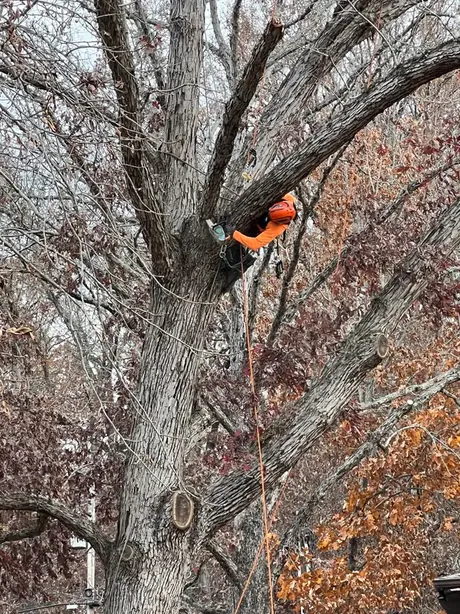
Somewhere along the line, cutting a tree's top off flat became a normal request. Homeowners around the lake ask for it because a tree is blocking a view of the water, growing too close to a roofline, or just looking too big for the yard. It seems simple: take the top off, problem solved. It is not simple, and it is not solved. We don't do it, and we tell people why every time it comes up.
What topping actually does
Topping means cutting large branches or the main leader back to stubs, with no regard for where a natural branch or bud is. A tree does not have a reserve of energy sitting around waiting to be spent on regrowth from wherever you happen to cut it. It stores energy in its branches and leaves, and topping removes a huge share of that storage in one afternoon. The tree's response is not calm regrowth. It is a stress response: a burst of weakly attached shoots called water sprouts, sprouting from just below every cut, growing fast and loose because the tree is trying to replace lost leaf area as quickly as it can.
Those water sprouts are the opposite of strong structure. They are attached to the trunk or stub with a shallow, poorly formed union, not the deep interlocking growth of a branch that developed naturally over years. Ten years after a topping cut, you often have a tree that is taller than it was before, full of narrow-angled regrowth, and considerably more likely to drop a limb in wind than it would have been if it had never been touched.
Each flat cut is also an open wound with no natural branch collar to help the tree seal it off. Decay organisms get in through that exposed wood, and because the cut is often on a large-diameter limb or the trunk itself, the tree has a much harder time compartmentalizing the damage than it would from a smaller, properly placed cut. A topped tree is frequently a tree that is quietly rotting from the inside for years before anyone notices.
Why it doesn't even solve the problem
The size problem that topping is usually meant to fix comes back, and it comes back faster than the original growth did, because a stressed tree throwing out water sprouts to recover leaf area grows aggressively in exactly the direction you were trying to reduce. A lot of the trees we get called out to actually remove started with a topping job from someone else years earlier, once the regrowth became unstable or the trunk started showing decay at the old cut sites.
What to ask for instead
If the actual goal is a smaller, safer, better-looking tree, there are proper techniques that get you there without the long-term damage. This is what our tree trimming and pruning work is built around.
- Crown reduction: the tree's overall height and spread are brought down by cutting back to a lateral branch large enough to take over as the new leader, not to a bare stub, so the tree's structure stays sound.
- Structural pruning: cuts made to correct weak branch unions, crossing limbs, or included bark before they become a failure point, done at the branch's natural attachment.
- Thinning: selectively removing some interior branches to let more light and air through the canopy, without changing the tree's overall shape or size.
- Canopy lifting: removing lower limbs to raise clearance over a driveway, deck, dock, or roofline, which is often what people actually want when they ask to have a tree 'topped' near a structure.
Our climbers also work trees that a bucket truck or aerial device cannot reach at all, which is common on the steep grades and soft lakeside ground you find around Camdenton, Osage Beach, Lake Ozark, Sunrise Beach, Laurie, and Gravois Mills. And when a tree is actually coming down rather than being pruned, our climbers do not use spikes unless removal is the plan, since spiking a tree that is staying puts unnecessary wounds in the bark for no reason.
A view of the lake without a wrecked tree
Most of the time, the thing people actually want, a clearer sightline to the water, more light on the deck, less shade over the roof, can be achieved with a reduction or a lift instead of a topping cut. It takes more judgment from the person doing the cutting, because every cut has to be placed with the tree's future structure in mind rather than just taken off flat at a convenient height. That is the trade our staff are trained to make, to Tree Care Industry Association standards, every time we're out on a job.
If a tree on your property is getting too big, too close to the house, or blocking the view you bought the place for, call us before anyone takes a chainsaw straight across the top of it. We serve Camden County and Morgan County, including Camdenton, Osage Beach, Lake Ozark, Sunrise Beach, Laurie, and Gravois Mills, and free on-site estimates are typically scheduled within a week.
Colt Tree Service LLC, (573) 347-3330
Call (573) 347-3330More articles
Emerald Ash Borer and Oak Wilt at the Lake of the Ozarks: What to Watch For
Ash and oak trees around the lake face two specific threats worth knowing the early signs of.
What Actually Happens to a Stump After the Tree Is Gone
Removing the tree is only half the job. Here's what actually happens to what's left behind.